Course Catalog
Explore All Courses
Find the perfect online class for your child's age and interests.
Filter By Category
Showing 1–5 of 5
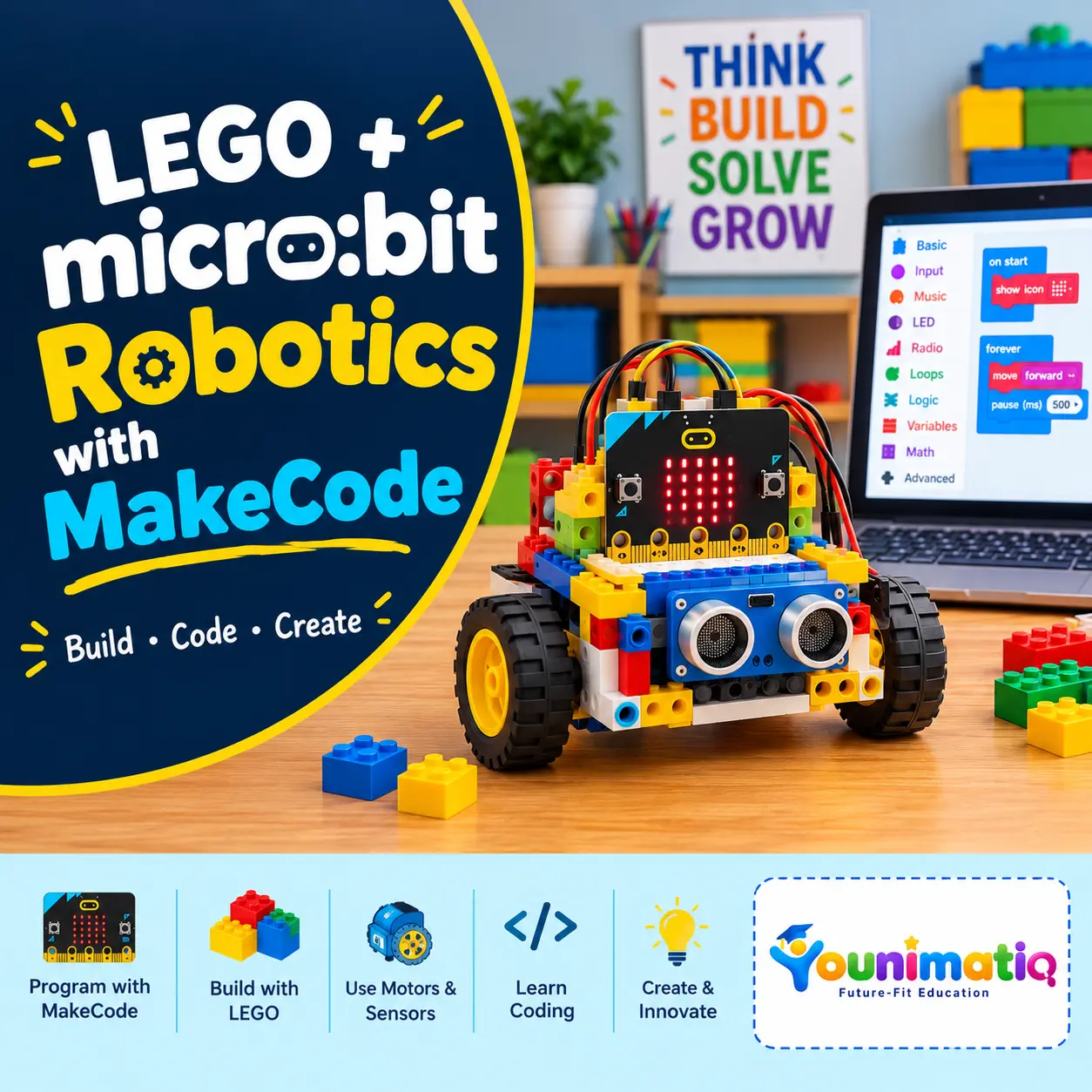
LEGO + micro:bit Robotics
LEGO + micro:bit Robotics with MakeCode is an 8-class beginner robotics program where students learn coding, engineering, and robotics by building interactive LEGO creations controlled by the micro:bit. Students progress from simple MakeCode programs and LEGO projects to motors, sensors, autonomous robots, and real-world robotics challenges—developing problem-solving, logical thinking, coding, and engineering skills along the way.Class 1: Meet micro:bit & MakeCode – Interactive LEGO Name BadgeExplore the micro:bit and MakeCode by creating an interactive LEGO name badge using buttons, LEDs, and animations.Class 2: Inputs, Outputs & Logic – LEGO Reaction GameLearn how inputs, outputs, events, and simple conditions work by building and coding a LEGO reaction game.Class 3: Smart LEGO Traffic Light – Mini Smart City JunctionBuild a mini city junction and program a LEGO traffic light using events, timing, and multiple outputs.Class 4: Build Your First Robot – LEGO micro:bit Robot CarBuild your first micro:bit-powered LEGO robot and program it to move forward, backward, and respond to commands.Class 5: Robot Navigation – LEGO Maze ChallengeUse motors, turns, loops, and step-by-step algorithms to program a robot through a LEGO maze.Class 6: Smart Sensor Robot – Obstacle-Avoiding RobotAdd sensors and IF/ELSE logic to create a robot that can detect obstacles and make autonomous decisions.Class 7: Robotics Mission – LEGO Delivery RobotCombine motors, sensors, loops, and problem-solving to build a robot that completes a real-world-inspired delivery mission.Class 8: Young Roboticist Challenge – Build Your Own Smart RobotDesign, build, code, debug, and present an original smart robot that solves a robotics challenge.
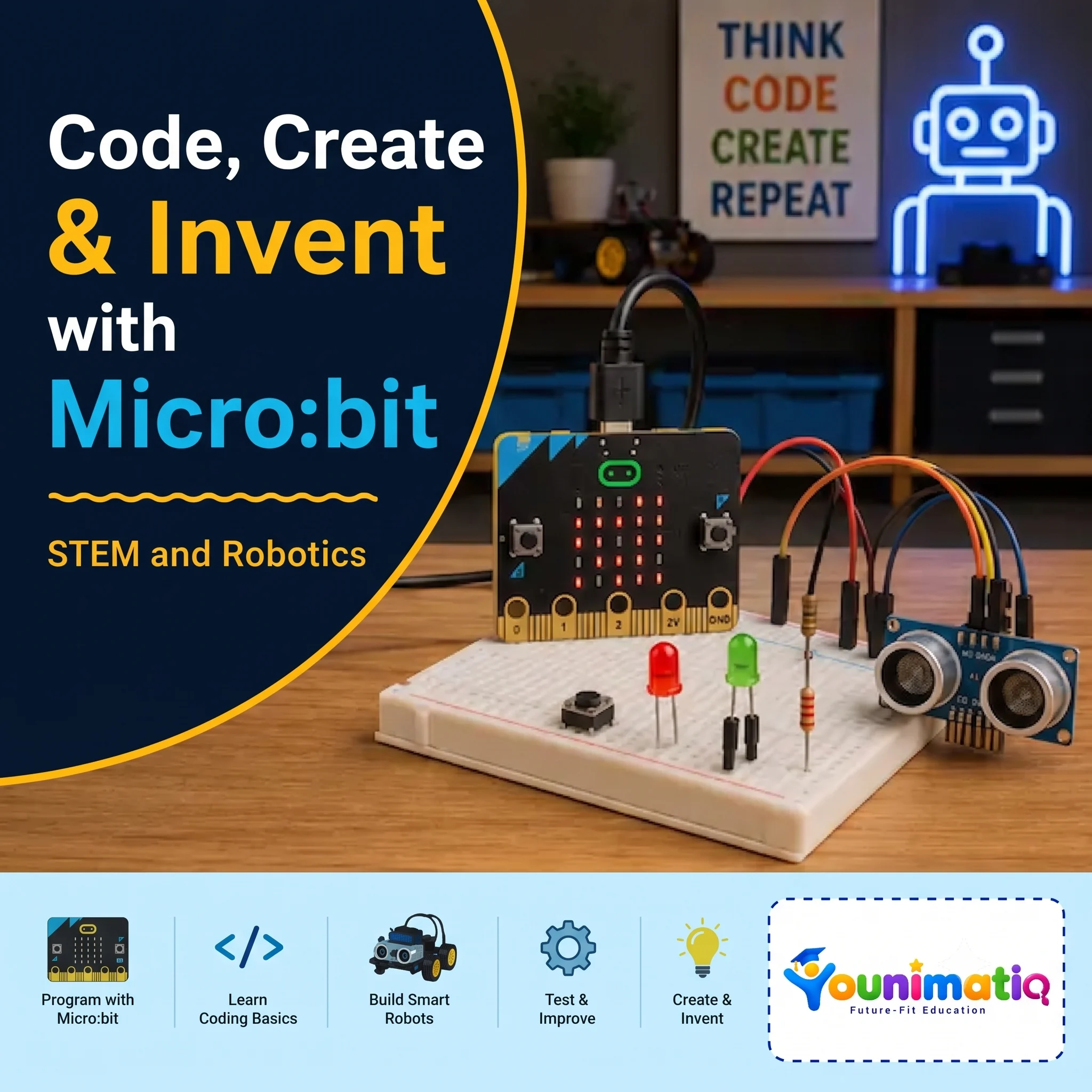
Code, Create & Invent with Micro:bit
Micro:bit Coding & Innovation is a hands-on course where students learn coding, electronics, sensors, and game design through creative micro:bit projects. They progress from basic programming to building interactive games, sensor-based projects, wearable technology, data visualizations, and electronic creations.By the end of the course, students develop coding, problem-solving, computational thinking, and engineering skills while turning their ideas into working projects.Class 1: Ahoy! – Introduction to micro:bitDiscover the micro:bit's LEDs, buttons, battery, and sensors while creating your first interactive program.Class 2: Light the Way – LEDs & CoordinatesLearn how LED coordinates work and create custom images and patterns on the micro:bit display.Class 3: Wireless – Communicating with micro:bitExplore wireless communication by sending messages between the micro:bit and interactive characters on the Tynker Stage.Class 4: High Rollers – Variables & Random NumbersLearn how variables store information and use random numbers to build a digital dice roller.Class 5: π-rates – Number Guessing GameUse variables, expressions, loops, conditions, and random numbers to create an interactive number-guessing game.Class 6: Two Sides of a Coin – Booleans & GesturesExplore true/false logic and micro:bit gestures while creating a shake-powered coin toss simulator.Class 7: M-oceanography – Arrays & LoopsLearn to store and manipulate data in arrays while using loops to create an animated wave project.Class 8: Game Night – Sprites & RadioBuild a fast-paced micro:bit Racer game while learning about sprites, game events, variables, and radio communication.Class 9: Sensory Overload – SensorsExplore the micro:bit's accelerometer, temperature sensor, and compass while creating an interactive Tag game.Class 10: Pins – Digital & Analog ElectronicsDiscover how micro:bit pins work with digital and analog signals while controlling external LEDs using alligator clips.Class 11: Devices – Motors & SpeakersConnect motors and speakers to the micro:bit and combine coding, sound, and motion to create a spinning prize wheel.Class 12: FUNctions – Reusable CodeLearn how functions, parameters, and conditional logic make programs more organized while building a Rock, Paper, Scissors game.Class 13: Soarin' Dragon – Game DesignTurn the micro:bit into a game controller and build a complete dragon game with movement, obstacles, scoring, and Game Over logic.Class 14: Glow Shoes – Wearable TechnologyUse the accelerometer, variables, pins, and LEDs to create a wearable project that responds to movement.Class 15: Grapher – Sensor Data VisualizationCollect sensor data from the micro:bit and turn it into plotted points to explore coding, data collection, and graphing.Class 16: Piano – Build a Paper PianoCombine coding, electronics, and creativity to build a playable paper piano using aluminum foil, pins, and the micro:bit.
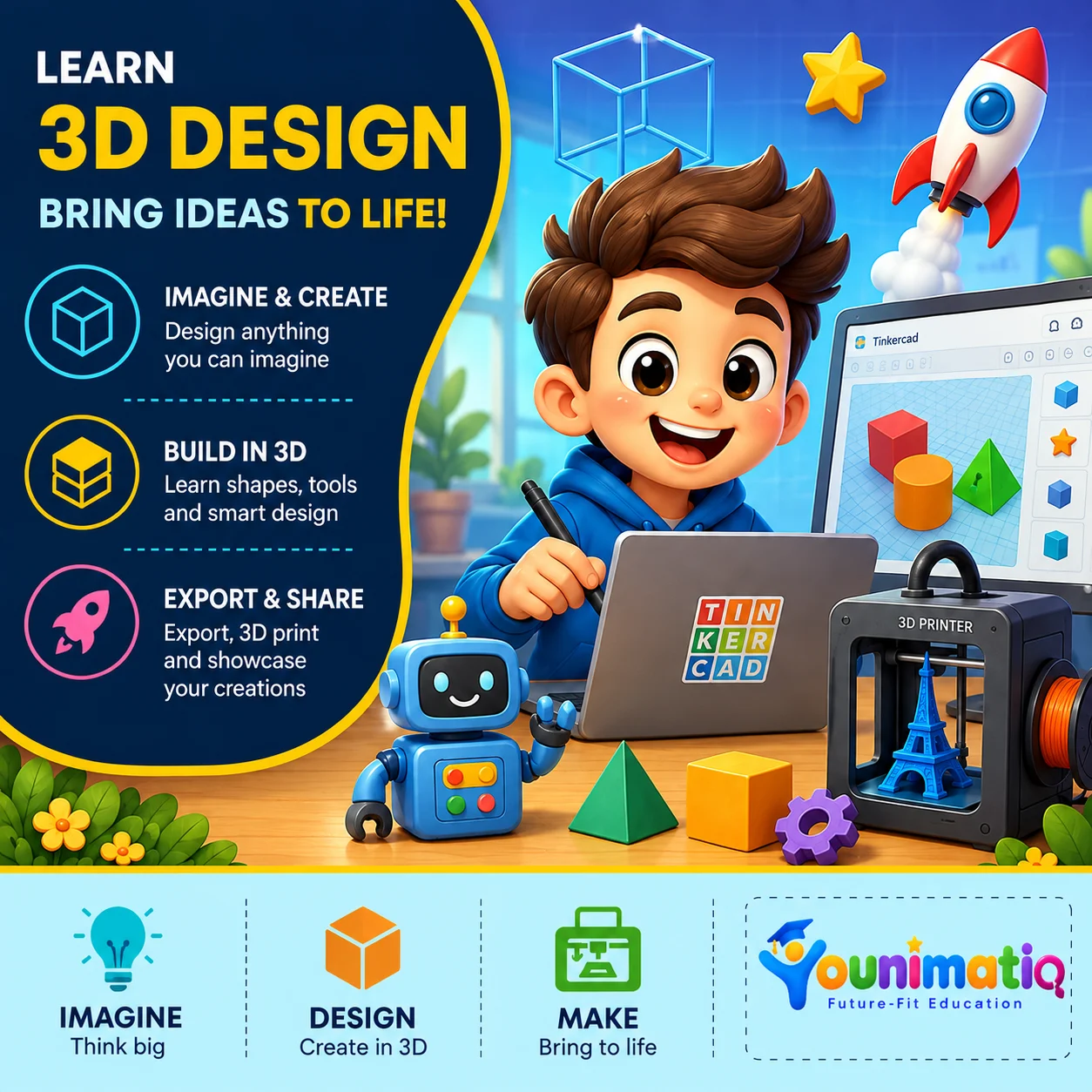
3D Design: Bring Ideas, Robots to Life
The 3D Design course introduces students to the exciting world of 3D modelling, digital design, and creative problem-solving. Using Tinkercad's beginner-friendly design tools, students learn how simple shapes can be transformed into imaginative 3D creations. Throughout the course, they explore geometric shapes, resizing, grouping, alignment, holes, duplication, rotation, and advanced design techniques while building fun projects such as characters, objects, structures, and personalised models. By the end of the course, students will have the confidence to turn their imagination into digital 3D designs and understand the basics of preparing models for real-world applications such as 3D printing.Class 1: Welcome to the World of 3D DesignStudents explore the Tinkercad workspace and create their first model using basic 3D shapes.Class 2: Shape Builders: Move, Resize & RotateStudents learn to transform basic shapes by moving, resizing, and rotating them in 3D space.Class 3: Shape Fusion: Grouping & Combining ObjectsStudents combine simple shapes to construct more detailed and creative 3D objects.Class 4: Design with Precision: Align & DuplicateStudents use precision tools to create balanced designs with repeated and symmetrical elements.Class 5: The Power of Holes: Cut & CarveStudents discover how hole shapes can be used to carve, cut, and transform 3D objects.Class 6: Character Creator: Build a 3D CharacterStudents bring imagination to life by designing their own unique 3D character.Class 7: Cool Creations: Designing Everyday ObjectsStudents apply their design skills to create functional objects inspired by everyday life.Class 8: Architects in 3D: Build a Mini StructureStudents become young architects by designing a creative structure in a 3D environment.Class 9: Minecraft-Inspired 3D Design ChallengeStudents create a fun game-inspired 3D model by transforming basic shapes into a detailed character or object.Class 10: Duplicate Like a Designer: Patterns & RepetitionStudents use duplication and repetition to create complex patterns quickly and efficiently.Class 11: From Digital Model to Real World: Introduction to 3D PrintingStudents discover how digital 3D models can be transformed into real physical creations through 3D printing.Class 12: Ultimate 3D Design Challenge: Imagine, Design & ShowcaseStudents design and showcase an original 3D creation that brings together everything learned throughout the course.
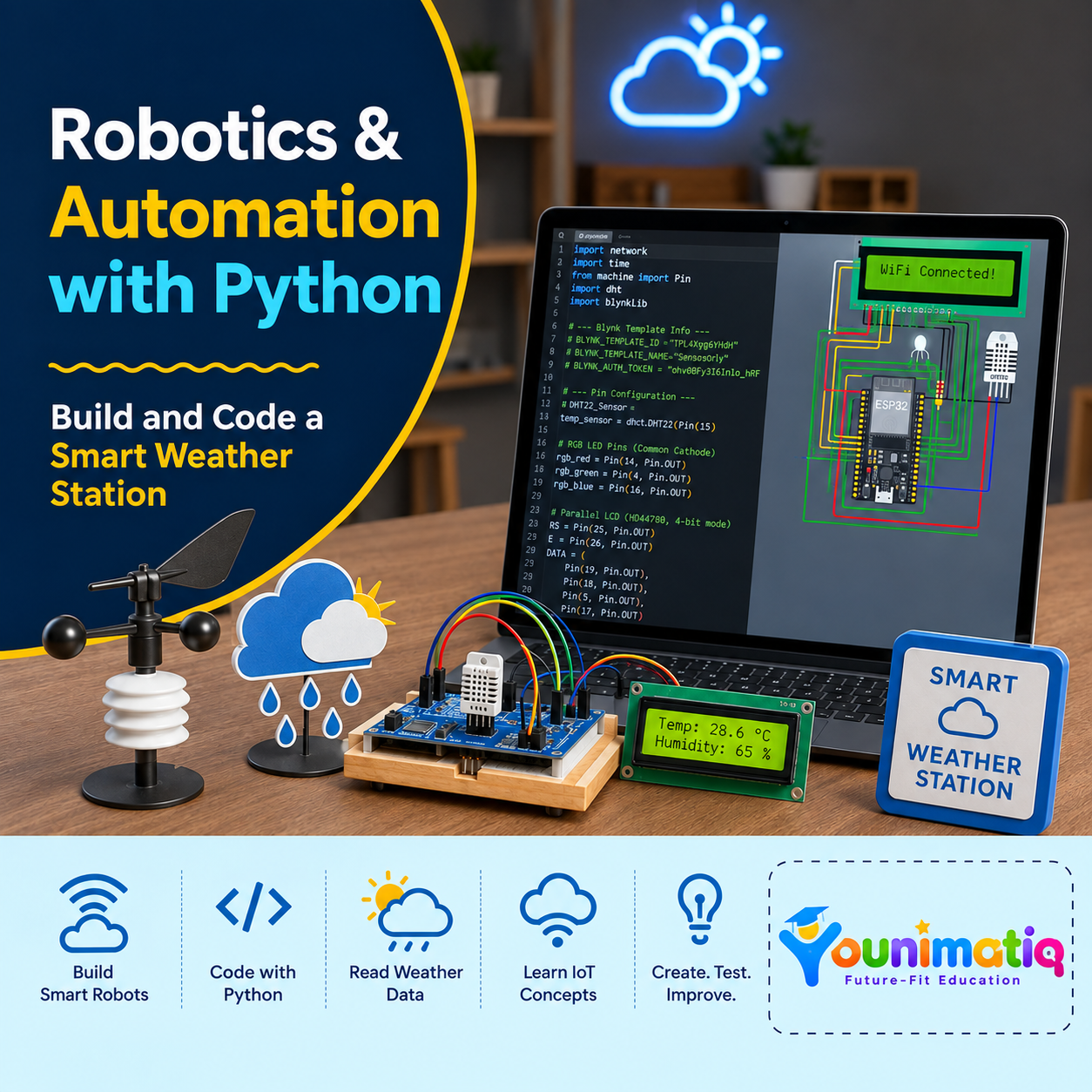
Robotics & Automation With Python
Robotics & Automation with Python introduces students to how Python can bring electronic projects to life using the Wokwi ESP32 simulator. This Robotics and Automation Course helps students start with simple LED and circuit controls and gradually build smart projects using sensors, motors, displays, and automated decision-making. Through projects such as a Smart Traffic Light, Hand Sanitizer Dispenser, Digital Weather Station, Security Alarm, and Smart Parking System, students learn to turn their ideas into working prototypes while developing coding, problem-solving, logical thinking, and engineering skills.Class 1: Smart Traffic Light Program multiple LEDs with Python to create an automated traffic-light sequence using GPIO, timing, and loops.Class 2: Light & Volume ControllerUse a potentiometer to adjust LED brightness and buzzer volume while learning how analog input controls output levels.Class 3: Smart Hand Sanitizer DispenserUse an ultrasonic sensor and servo motor to automatically dispense sanitizer when a hand is detected.Class 4: Motion-Sensing Smart RoomDetect movement with a PIR sensor and use Python logic to automatically control room lights and a smart door.Class 5: Digital Weather Station – Part 1Read temperature and humidity from a DHT22 sensor and process the sensor data using Python.Class 6: Digital Weather Station – Part 2Display temperature and humidity readings on an LCD using Python functions, conditions, and formatted output.Class 7: Smart Security AlarmBuild a motion-triggered security system using a PIR sensor, buzzer, and LEDs.Class 8: Automatic Night LightUse an LDR to detect light levels and automatically control an LED based on brightness.Class 9: Smart Parking SystemUse an ultrasonic sensor to detect vehicles and control a servo barrier with LED indicators.Class 10: Smart Home Control CenterCombine sensors, outputs, functions, and Python logic to create an integrated home automation system.Class 11: Gas Leak DetectorMonitor gas sensor readings and trigger LED and buzzer alerts when the gas level exceeds a set threshold.Class 12: Smart Robotics ChallengeCombine sensors, actuators, conditions, loops, and functions to design and simulate an original smart automation system in Wokwi.