Younimatiq logo

Academics

Academics Courses

Showing 1–2 of 2

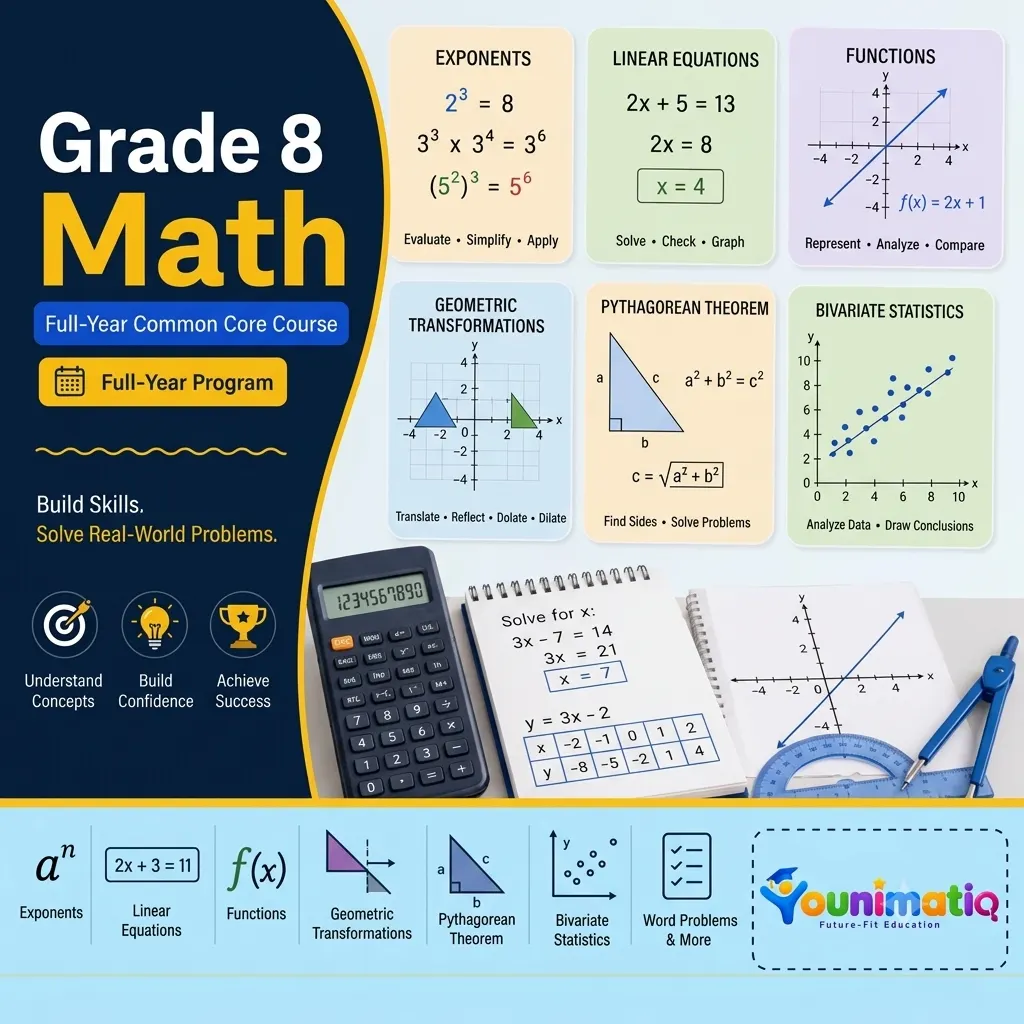
Grade 8 Math — Full-Year Common Core Course
Live Class Academics Math

Grade 8 Math — Full-Year Common Core Course

This course completes middle school mathematics and builds the direct foundation for high school algebra, covering six core strands: exponents and scientific notation, linear equations, functions, geometric transformations, the Pythagorean theorem, and bivariate statistics. Sessions move students from numerical reasoning into formal algebraic and functional thinking, and introduce transformational geometry and informal proof — the capstone of the K–8 progression.Course Strands & Progression1. Exponents, Radicals & the Number SystemKnow and apply the properties of integer exponentsUse square roots and cube roots to represent solutions to equationsExpress very large and very small numbers using scientific notation, and perform operations with numbers in scientific notationUnderstand that not all numbers are rational, and approximate irrational numbers using rational approximations2. Linear Equations & SystemsSolve linear equations in one variable, including equations with variables on both sidesUnderstand solutions to linear equations as points on a line, and analyze slope and interceptsSolve systems of two linear equations by graphing, substitution, and eliminationSolve real-world and mathematical problems leading to systems of linear equations3. FunctionsUnderstand that a function assigns exactly one output to each inputCompare properties of two functions represented in different ways (tables, graphs, equations, verbal descriptions)Interpret the equation y = mx + b as defining a linear function, and construct functions to model linear relationshipsDescribe qualitatively the functional relationship between two quantities from a graph4. Geometric Transformations & Congruence/SimilarityVerify experimentally the properties of rotations, reflections, and translationsUnderstand congruence and similarity using physical models, transparencies, or geometry softwareDescribe the effect of dilations, translations, rotations, and reflections on two-dimensional figures using coordinatesUnderstand and apply facts about angles formed by parallel lines cut by a transversal, and angle sums of triangles5. The Pythagorean TheoremExplain a proof of the Pythagorean theorem and its converseApply the Pythagorean theorem to determine unknown side lengths in right triangles, in real-world and mathematical problemsApply the Pythagorean theorem to find the distance between two points in a coordinate systemSolve real-world problems involving volume of cylinders, cones, and spheres6. Bivariate StatisticsConstruct and interpret scatter plots for bivariate measurement dataDescribe patterns of association (clustering, outliers, positive/negative association, linear/nonlinear)Fit a straight line to data that suggests a linear association, and informally assess model fitUse the equation of a linear model to solve problems in contextConstruct and interpret two-way tables for categorical data

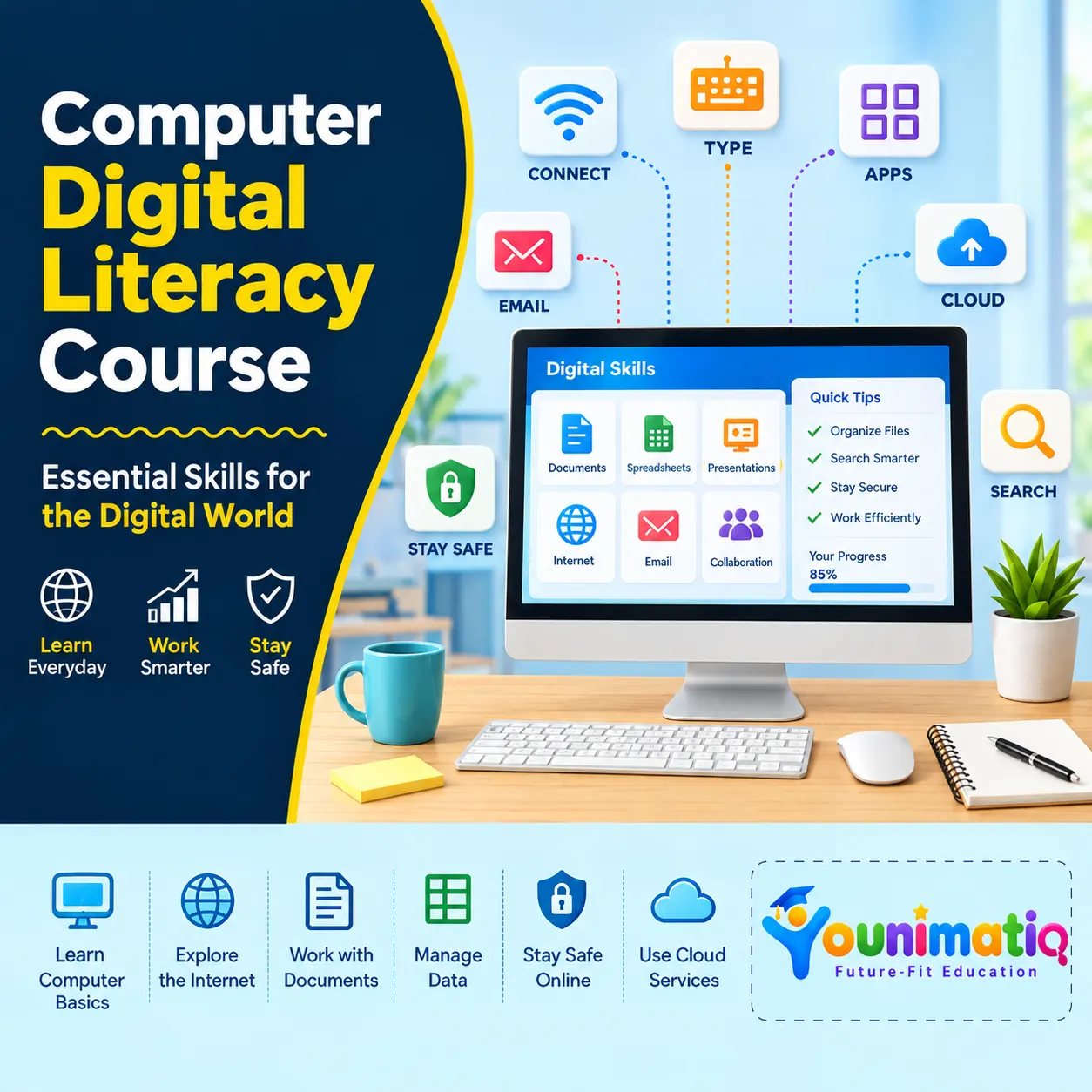
Computer & Digital Literacy Course - Level 1
Live Class Academics Computer Science

Computer & Digital Literacy Course - Level 1

Computer & Digital Literacy course - Level 1 helps students build a strong foundation in how computers work, how information is stored and processed, how to manage digital files, search for reliable information, protect themselves online, and understand their digital footprint. The level begins with an engaging binary and logic challenge and gradually develops practical computer and digital citizenship skills through hands-on activities and a final Digital Citizenship Audit. Level 1: Computer Systems & Digital CitizenshipTrial Class: Crack the CodeDecode binary messages, create a binary name badge, design a yes/no algorithm with a flowchart, and turn it into a working Python program using if, else, and print().Class 1: How a Computer Processes a TaskLearn how computers process information through the Input–Process–Output–Storage cycle and practice troubleshooting common problems.Class 2: File Systems, Cloud Storage & Version ControlLearn to organize files using naming conventions while understanding the difference between local storage, cloud synchronization, and version control.Class 3: Advanced Keyboarding & Workflow EfficiencyImprove typing speed and accuracy while learning keyboard shortcuts and window-management techniques for faster computer workflows.Class 4: Advanced Search & Source EvaluationLearn to use Boolean search operators and evaluate online sources for credibility, bias, and currency.Class 5: Cybersecurity FundamentalsLearn how to recognize phishing attempts and create a personal password-safety plan using strong passwords, 2FA, and password-management strategies.Class 6: Digital Footprint + Unit Wrap-UpExplore how online activity can affect digital reputation and demonstrate learning through a Digital Citizenship Audit and quiz.

Book a Free Class

Tell us a bit about your child to book a free demo class for the selected course.