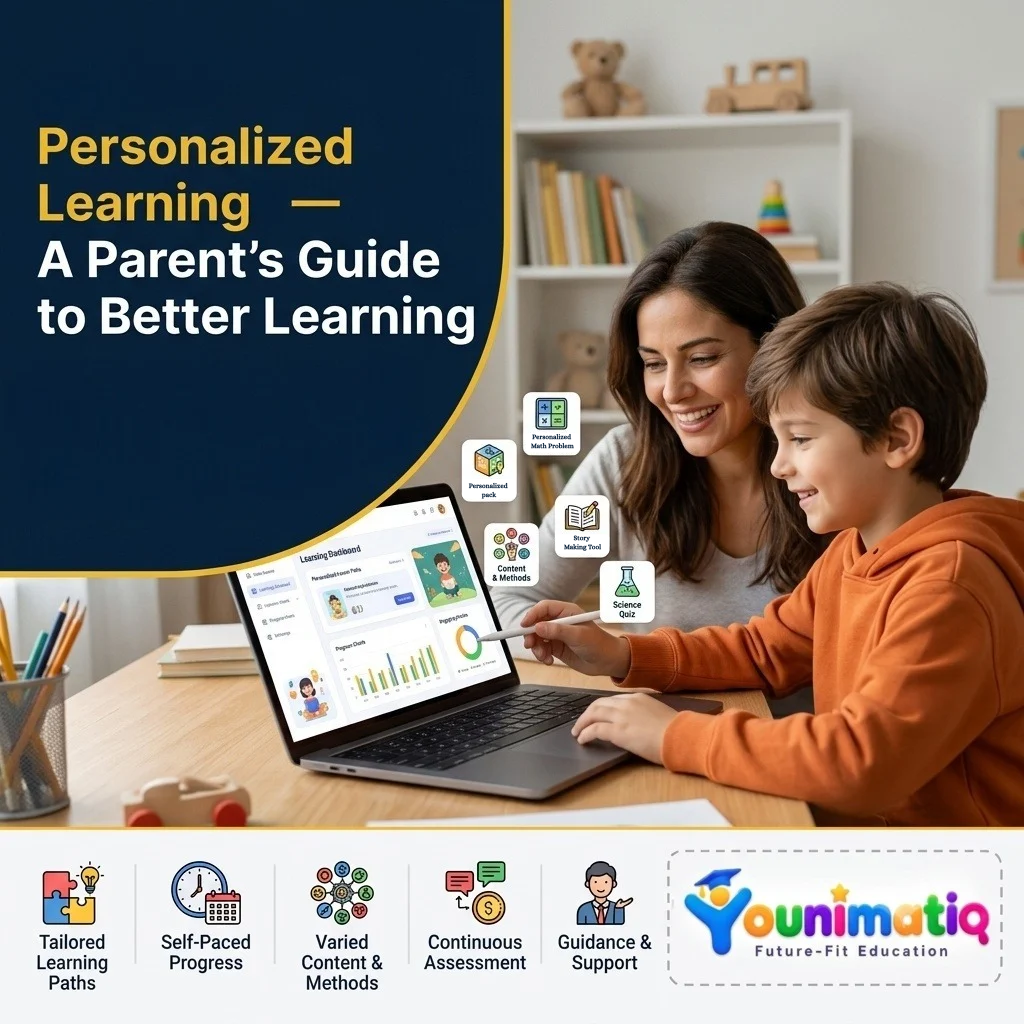
Every child learns differently. One child may understand a math problem after seeing a visual example, while another may need to work through several examples. Some children enjoy asking questions and exploring ideas. Others learn better by building, creating, reading, or practicing.
This is where personalized learning for kids can make a difference.
Personalized learning means adapting learning to a child’s needs, interests, pace, and learning goals instead of expecting every child to follow exactly the same path. For parents, the idea can sound simple, but it also raises practical questions: What does personalized learning actually look like? How is it different from regular tutoring? And how can you tell if it is right for your child?
Let’s look at it in a practical way.
What Is Personalized Learning?
Personalized learning is an approach where learning is adjusted to better fit an individual student.
Instead of giving every child the exact same activities, the learning experience can take into account things such as:
- What the child already understands
- Where they need more practice
- Their interests
- Their learning pace
- The subjects or skills they want to develop
- How they prefer to explore and apply ideas
For example, imagine two students are learning fractions.
One student understands fractions quickly but struggles to apply them to word problems. Another understands word problems but needs more practice with basic fraction concepts.
A personalized approach can give each student different practice based on what they need instead of having both students repeat the same worksheet.
The goal is not simply to make learning easier. It is to make learning more relevant and useful for the individual child.
How Is Personalized Learning Different From Traditional Learning?
In a traditional classroom, teachers often have to work with a group of students at the same time. They may have a curriculum, lesson plan, assignments, and a specific amount of material to cover.
That structure is important, but children within the same classroom can still have very different needs.
One child may be ahead in math but need additional support with reading. Another may understand the academic material but need more opportunities to apply it.
Personalized learning gives more room to adjust the learning experience around those differences.
For example:
Traditional approach:
Everyone learns the same topic → completes similar work → moves forward together.
Personalized approach:
The child’s current understanding is considered → learning activities are adjusted → the child gets opportunities to practice, explore, and apply the concept.
This does not mean replacing school. Personalized learning can work alongside a child’s regular education as additional academic support, enrichment, or skill development.
What Does Personalized Learning for Kids Look Like?
Personalized learning can take many forms. It does not have to mean sitting in front of a computer and completing digital exercises.
For children, it can include:
1. Learning at an Appropriate Pace
Children do not always understand new concepts at the same speed.
If a student needs more time with multiplication, moving immediately to a harder topic may create unnecessary frustration. On the other hand, a student who already understands the concept may benefit from a more challenging problem.
Personalized learning allows practice and challenges to be adjusted based on the child's needs.
2. Connecting Learning With Interests
A child's interests can provide a useful starting point for learning.
A child who enjoys games may be interested in exploring math through game-based activities. A child who likes technology may be curious about coding or robotics. Another child may enjoy art, storytelling, or science experiments.
When children can connect a subject with something they already enjoy, the learning activity can feel more meaningful.
For example, instead of treating Minecraft as simply a game, learning activities can use Minecraft as a context for exploring math, science, coding, or other subjects.
This is one idea behind Younimatiq's approach to learning: Turn Screen Time Into Skill Time.
Personalized Learning Can Connect Different Subjects
Children often learn subjects separately at school: math, science, English, technology, and art.
But real-world problems rarely fit into just one subject.
Consider a child creating a simple game.
They might use:
- Math to work with numbers, measurements, or logic
- Coding to create rules and interactions
- Art to design characters or visuals
- Writing to develop the game's story
- Problem-solving to figure out what works and what needs to change
This kind of learning can help children see connections between different areas of knowledge.
Younimatiq refers to this idea as Polymath Learning — connecting ideas across subjects and giving children opportunities to explore, apply, and create.
The purpose isn't to make every child study everything. It is to help children understand that knowledge can connect.
Does Personalized Learning Mean Children Can Learn Whatever They Want?
No.
Personalized learning does not mean removing structure or letting children avoid subjects they find difficult.
Children still need foundational knowledge and skills. A personalized approach can simply change how they work toward those learning goals.
For example, a child may not enjoy traditional math practice but may enjoy solving problems through a game or real-world challenge. The mathematical skill remains important; the learning experience is adjusted.
This balance matters.
Children need guidance, clear goals, practice, and support. They also benefit from having opportunities to explore areas that interest them.
What Are the Benefits of Personalized Learning?
The benefits can vary from one child to another, but personalized learning can help address several common learning needs.
Better Support Where a Child Needs It
If a child is struggling with a particular concept, they can spend more time practicing it.
If they have already mastered a topic, they can move toward more challenging work rather than repeating material they already understand.
More Relevant Learning
A child's interests can be used to create meaningful learning connections.
For example, coding can connect with a child's interest in games. Science can connect with curiosity about how things work. Art can connect with technology through animation and digital creation.
Opportunities to Apply Knowledge
Understanding a concept is one step. Using it is another.
Personalized learning can include activities where children solve problems, build projects, explain their thinking, or create something of their own.
That can make learning more active than simply memorizing information.
Development Beyond One Subject
Children need academic knowledge, but they also need skills such as problem-solving, creativity, communication, and the ability to think critically.
A personalized learning experience can bring these skills into subject-based learning instead of treating them as completely separate.
How Can Parents Tell If Personalized Learning Is Working?
You do not need to judge progress only by grades.
Pay attention to what your child can actually do.
Ask questions such as:
- Can my child explain what they learned in their own words?
- Can they apply the concept to a new problem?
- Are they becoming more comfortable asking questions?
- Are they able to work through mistakes?
- Are they showing interest in learning something beyond the assignment?
- Can they connect ideas from different subjects?
Also look at areas where your child still needs support.
Personalized learning should respond to those gaps rather than simply making activities more entertaining.
Personalized Learning for Kids in an Online Setting
Online learning can be personalized when the experience goes beyond simply watching videos or completing digital worksheets.
A useful online learning experience can include live instruction, practice, projects, feedback, and opportunities to ask questions.
For example, a child interested in coding might work with a mentor on a coding activity, receive feedback, and then use what they learned to create something.
Younimatiq provides online learning for K–12 students across areas such as math, coding, science, AI, robotics, AI literacy, Minecraft, Roblox, arts, and animation.
The learning experience can also combine subjects with children's interests. Examples include Minecraft Math, Minecraft Science, Minecraft Coding, and Minecraft AI.
The idea is to help children learn through subjects and activities that connect with how they naturally like to explore.
What Should Parents Look for in a Personalized Learning Program?
Before choosing a program, look beyond the word "personalized."
Ask how personalization actually works.
Look at the Learning Approach
Does the program adjust activities based on what your child understands and needs?
Check the Subjects and Skills
Make sure the program supports the areas your child needs help with or wants to explore.
Ask About the Learning Format
Find out whether learning includes live classes, individual support, group learning, projects, practice, or other activities.
Consider Your Child's Interests
If your child loves technology, games, art, or science, check whether those interests can become part of the learning experience.
Look for Clear Learning Goals
Personalization should still have direction. The program should help your child work toward meaningful academic or skill-based goals.
How Younimatiq Approaches Personalized Learning
Younimatiq is an online personalized learning platform for K–12 students.
Its learning areas include math, coding, science, AI, robotics, AI literacy, Minecraft, Roblox, arts, and animation.
The approach focuses on helping children connect learning with their interests while developing knowledge and practical skills.
Younimatiq also offers different learning formats, including 1:1 classes, 1:M classes, homework help, and AI Robotics Master Classes.
Its curriculum is aligned with educational standards and frameworks including Common Core, CBSE, ICSE, and Cambridge (IGCSE), with additional U.S. standards alignment for selected offerings.
For parents, the bigger question is simple: Can my child learn in a way that makes sense for them while still building the skills they need?
That is the purpose personalized learning aims to address.
Frequently Asked Questions
Is personalized learning good for kids?
Personalized learning can be useful when it responds to a child's current learning needs, interests, pace, and goals. Its effectiveness depends on how the program is designed and how well it supports the individual student.
What is the difference between personalized learning and tutoring?
Tutoring generally focuses on helping a student with specific academic needs. Personalized learning can include tutoring-style support, but it can also involve adapting pace, activities, interests, projects, and learning goals across different subjects and skills.
Is personalized learning only for children who are struggling in school?
No. It can support children who need additional academic help as well as children who want to explore subjects more deeply or develop new skills.
Can personalized learning work with regular school?
Yes. Personalized learning can complement a child's regular school education. It can provide additional practice, enrichment, homework help, or opportunities to explore areas such as coding, AI, robotics, and creative skills.
How do I know if my child needs personalized learning?
Think about where your child currently needs support and where they want more challenge. If they struggle with certain concepts, lose interest in repetitive work, or want to explore a particular skill more deeply, a personalized approach may be worth considering.
Can games be part of personalized learning?
Yes. Games and game-based activities can provide a context for learning when they are designed around clear educational goals. For example, familiar environments such as Minecraft can be connected with subjects such as math, science, coding, and AI.
Helping Your Child Learn in a Way That Fits
Children don't all learn in the same way, and they don't need to follow exactly the same path to develop strong skills.
Personalized learning for kids gives parents and educators another way to think about learning: start with what the child knows, understand where they need support, connect learning with their interests, and give them opportunities to apply what they learn.
For some children, that might mean extra math practice. For others, it could mean building a coding project, exploring robotics, creating art, or using a favorite game as a starting point for learning.
The goal is simple: help children connect ideas, apply knowledge, and become confident learners.
