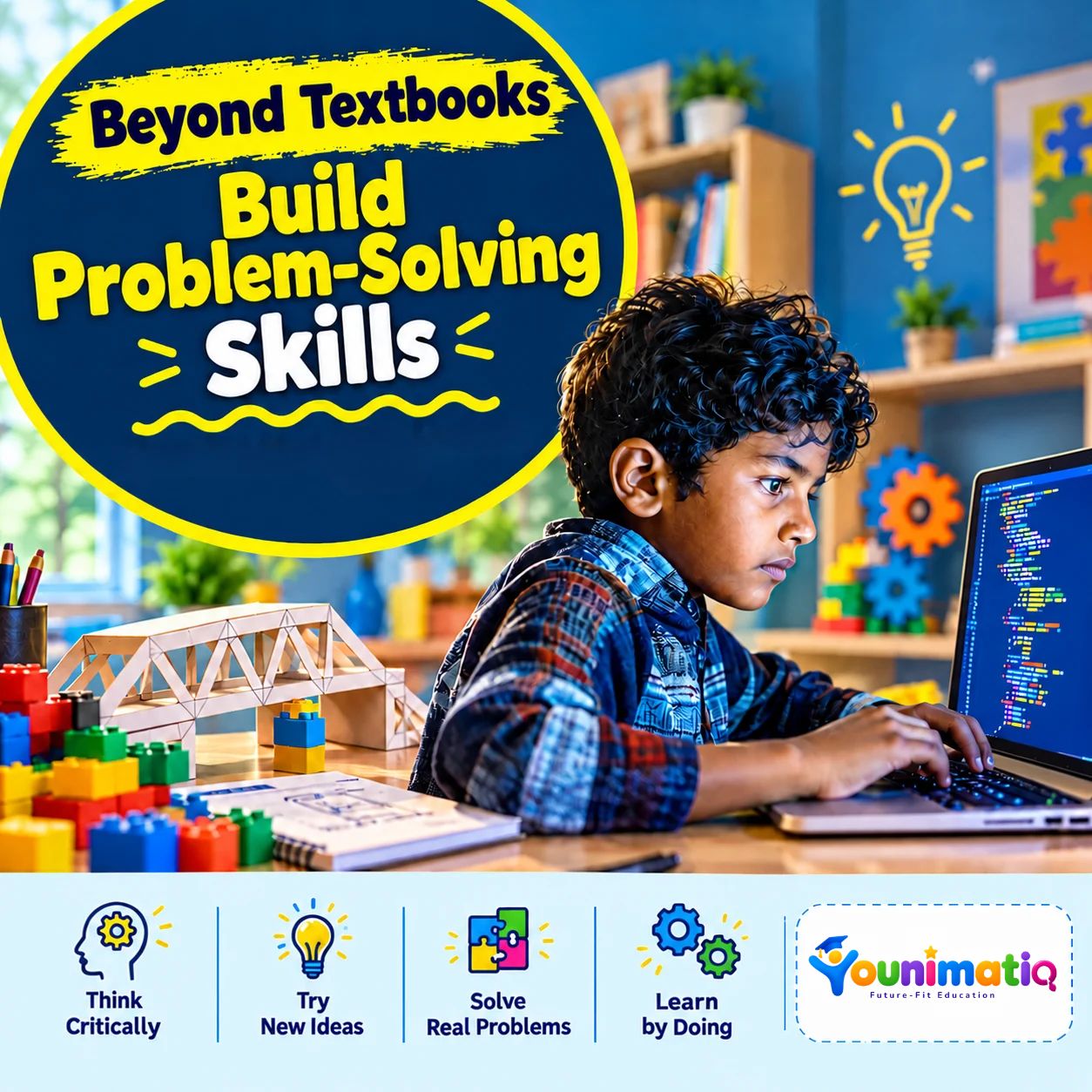
Children learn many things at school, from solving maths problems to understanding science and reading stories. But knowing the correct answer is only one part of learning. Children also need opportunities to use what they know, make decisions, and find solutions when something doesn't go as planned.
Parents can help develop these abilities through simple activities at home. Everyday tasks, family conversations, games, and creative projects can give children opportunities to practise problem solving skills without making learning feel like another school assignment.
Here are seven practical ways to help your child become a more confident and independent problem-solver.
1. Turn Everyday Tasks into Learning Opportunities
Children can practise problem-solving during ordinary household activities. You don't need to prepare special lessons or buy new materials.
For example, when preparing a meal, ask your child to help measure ingredients. If a recipe needs two cups of flour and you have a half-cup measuring cup, ask how many times they need to fill it. This gives them a chance to apply maths in a real situation.
You can try similar activities while shopping, organizing a study table, packing for a trip, or planning a family outing.
Try asking:
- What do we need to complete this task?
- How could we organize these things?
- Is there another way to solve this problem?
These small challenges help children practise planning, reasoning, and decision-making.
2. Encourage More Than One Solution
Many problems have several possible solutions. Children benefit from learning that they can explore different approaches instead of searching for just one correct answer.
Suppose your child is building a tower with blocks, but it keeps falling over. Instead of fixing it yourself, ask what might make it more stable. Your child might try a wider base, use larger blocks at the bottom, or change the arrangement.
Some ideas may work, while others may not. Both outcomes can help children understand what happens when they change their approach.
This is one of the useful problem solving techniques parents can encourage: trying an idea, observing the result, and making adjustments.
Give your child time to experiment before stepping in. If they get stuck, offer a small hint rather than explaining every step.
3. Involve Your Child in Everyday Decisions
Decision-making gives children a chance to compare options and think about consequences.
For example, when planning a family outing, let your child help compare two possible activities. Discuss the cost, travel time, weather, and what everyone might enjoy. For younger children, keep the choices simple.
You could also ask them to help organize a weekly study schedule or decide how to divide time between homework and hobbies.
The aim isn't to make children responsible for every family decision. It is to help them understand how to consider different factors before choosing an option.
Ask questions such as:
- What are our choices?
- What might happen if we choose this option?
- Which option makes the most sense, and why?
Over time, these conversations can help children explain their reasoning and make more thoughtful decisions.
4. Turn Their Questions into Small Investigations
Children often ask questions about things they notice around them. Instead of immediately giving an answer, encourage them to explore it.
If your child wonders why some objects float while others sink, you could test a few safe household objects in a bowl of water. Ask your child to predict what will happen before testing each object.
After the activity, discuss what they observed and whether their predictions were correct.
You can use the same approach with simple science experiments, gardening, shadows, magnets, or other age-appropriate activities.
A basic investigation follows a few steps:
- Ask a question.
- Make a prediction.
- Test the idea safely.
- Observe what happens.
- Discuss what you learned.
These problem solving steps help children move from guessing to observing, testing, and explaining their ideas.
5. Use Games to Practise Strategic Thinking
Puzzles, board games, building challenges, and selected digital games can give children opportunities to solve problems in an engaging way.
For example, a puzzle encourages children to recognize patterns and work out where pieces fit. A strategy-based board game may require them to think ahead and adjust their plans when another player makes a move.
Building games such as Minecraft can also provide opportunities to practise planning, spatial reasoning, and creative problem-solving. The learning depends on the activity and how children engage with it, so the game alone does not guarantee these outcomes.
After playing, ask your child what strategy they used, what worked, and what they might change next time.
For younger children, start with simple puzzles and building tasks. As they become more comfortable, introduce challenges that require several steps to complete.
6. Let Children Make Mistakes and Try Again
When a child struggles with a task, it can be tempting to solve the problem for them. However, giving them a chance to work through the difficulty can help them learn how to approach similar situations in the future.
Imagine your child is trying to create a simple paper bridge that can hold a few small objects. If the bridge bends or collapses, ask what could be changed. They might fold the paper differently, add support, or try another design.
The first attempt doesn't have to succeed. What matters is helping your child understand why something happened and what they could try next.
For more complex problem solving, encourage them to break a difficult task into smaller parts. A large school project, for instance, may become easier when divided into research, planning, creating, and reviewing.
Recognize their effort and reasoning rather than focusing only on whether they got the answer right.
7. Ask Questions That Connect Learning to Real Life
One of the easiest ways to encourage deeper thinking is to change the questions you ask after school or during homework.
Instead of asking only, "What did you learn today?", try asking how your child could use that knowledge.
If they learned fractions, ask where fractions might appear while sharing food or measuring ingredients. If they studied plants, ask what a plant needs to grow at home. If they learned basic coding, ask what simple problem they could solve by creating a program.
Here are a few more questions to try:
- How would you solve this problem?
- Can you think of another way?
- What would you do if your first idea didn't work?
- How could you explain this to someone younger than you?
- Where might you use this skill outside school?
Give your child enough time to think before answering. They may need to explain their ideas aloud, draw a picture, or try an example before they can describe their reasoning clearly.
These conversations help connect classroom knowledge with practical situations.
How Can Parents Help Children Develop Better Problem-Solving Skills?
You don't need to turn every activity into a lesson. Start with one or two small changes and build from there.
- Let children think first. Avoid providing an immediate answer when they can explore the problem themselves.
- Ask open-ended questions. Encourage them to explain their ideas instead of responding with only yes or no.
- Break down difficult tasks. Help them identify smaller steps when a problem feels overwhelming.
- Make room for experimentation. Allow children to test ideas in safe, age-appropriate ways.
- Recognize their reasoning. Notice when they compare options, ask useful questions, or adjust their approach.
Children develop these abilities at different rates. Offer challenges that suit their age and current skills, and provide support when they need it.
Helping Children Learn Beyond Textbooks with Younimatiq
Children benefit when they have opportunities to explore ideas and put their knowledge into practice. Hands-on activities can help them connect concepts, test solutions, and discover how different skills work together.
At Younimatiq, children can explore learning through areas such as coding, robotics, Minecraft-based education, science, and AI literacy. These learning experiences can give children opportunities to create projects, experiment with ideas, and practise solving problems with guidance.
The goal is to help children build a stronger connection between what they learn and what they can do with that knowledge.
Start small at home. Ask a thoughtful question, offer a simple challenge, and give your child time to work through it. With regular opportunities to practise, children can become more comfortable approaching unfamiliar problems and explaining their ideas with confidence.
