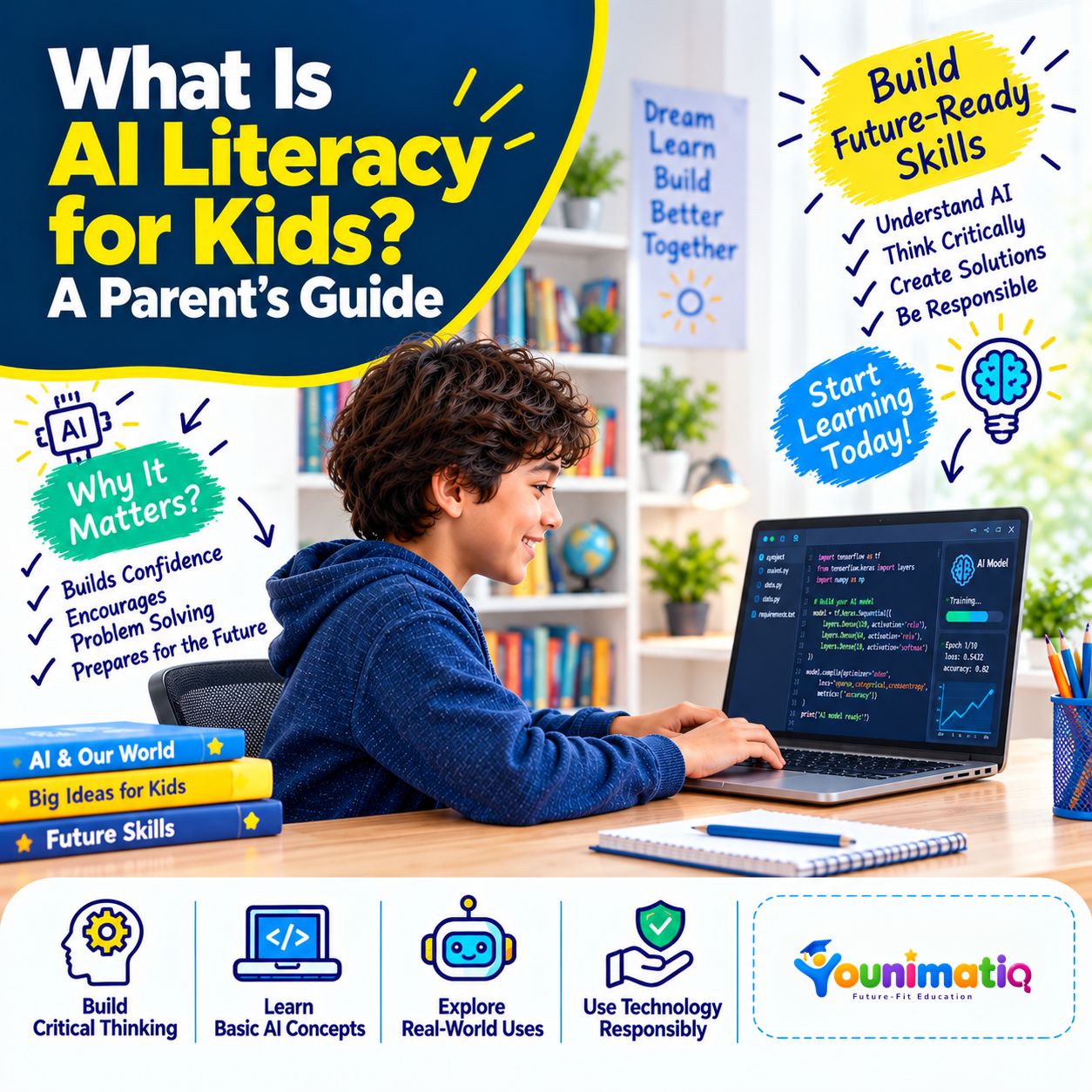
Artificial intelligence is becoming part of many tools children already use, from search engines and educational platforms to games and creative applications. This makes it useful for children to understand what AI is, how it works at a basic level, and how to use it responsibly.
This is where AI literacy comes in. Children do not need to become AI engineers to develop AI literacy. They need age-appropriate knowledge that helps them understand AI, question its results, and use AI tools thoughtfully.
For parents in cities such as Bangalore, Mumbai, Delhi, and Kolkata, AI literacy can be a useful part of a child's broader digital and academic learning.
What Is AI Literacy?
AI literacy means having a basic understanding of artificial intelligence and knowing how to interact with AI responsibly.
For children, this can include learning:
- What artificial intelligence is
- How AI systems use data and patterns
- Where children may encounter AI in everyday life
- What AI can and cannot do
- How to check information produced by AI
- Why privacy and responsible use matter
- How AI can support learning and creativity
The goal is not to make every child an AI specialist. It is to help them become informed users and, as they grow, confident creators.
Why Do Kids Need AI Literacy?
Children are growing up around technology that increasingly uses AI. They may come across AI while searching for information, using learning platforms, creating images, playing games, or interacting with digital assistants.
Without basic understanding, it can be easy to assume that an AI system is always correct.
AI literacy helps children develop a more thoughtful approach. For example, if an AI tool gives an answer to a school question, a child can learn to ask:
“How do I know this answer is correct?”
That simple habit encourages verification and critical thinking.
AI literacy can also help children understand that AI does not think and understand the world in exactly the same way people do. It works with data, patterns, and instructions to produce results.
What Should Children Learn About AI?
The right level of AI education for kids depends on their age and learning experience. Younger children can start with simple concepts, while older students can explore more technical ideas.
1. Understanding What AI Is
Start with everyday examples rather than complicated technical explanations.
Children can learn that AI is used in different types of digital systems to perform tasks such as recognising patterns, making predictions, recommending content, or responding to questions.
The explanation should match the child's age. A younger child might simply learn what AI does, while an older child can begin exploring how models learn from data.
2. Learning About Data
Data is an important part of many AI systems.
Children can explore simple examples of how information can be organised and used to identify patterns. For example, they might sort pictures into categories and think about what features help them decide where each picture belongs.
Activities like these can introduce ideas that later connect with machine learning.
3. Understanding AI Limitations
One of the most important lessons is that AI can make mistakes.
Children should understand that an AI-generated answer may contain incorrect or incomplete information. They should learn to compare important information with reliable sources rather than accepting every answer immediately.
This is especially useful for schoolwork and research.
4. Responsible AI Use
AI education should also include responsible behaviour.
Children can learn about:
- Protecting personal information
- Checking information before sharing it
- Respecting other people's work
- Using AI to support learning rather than simply copying answers
- Thinking about the possible effects of technology on people
These habits can help children become more responsible digital users.
Simple Ways Parents Can Teach AI Literacy at Home
Parents do not need advanced technical knowledge to start conversations about AI.
Ask How a Digital Tool Works
When your child uses a recommendation system, voice assistant, search tool, or AI-powered application, ask what they think happens behind the screen.
You can discuss how the system might use information or patterns to produce a result.
Encourage Fact-Checking
If your child gets an answer from an AI-powered tool, ask them to check it using a trusted source.
This turns technology use into a learning opportunity instead of encouraging blind trust.
Discuss AI-Generated Content
Children may encounter AI-generated images, text, videos, or other content online. Talk about how digital content can be created or changed with technology.
The aim is to help children become more careful about what they see and share online.
Use Small Projects
Simple projects can make AI concepts easier to understand.
For example, older children can explore how a system might classify images or text. They can think about the data needed for a particular task and what could happen if the data is incomplete or inaccurate.
Project-based learning can make abstract concepts easier to connect with real situations.
AI Education for Kids Should Go Beyond Using AI Tools
Knowing how to type a question into an AI tool is only one small part of AI education for kids.
A stronger learning experience also teaches children why an AI system produces certain results, how to evaluate those results, and how to use technology responsibly.
For older children, this can gradually connect with areas such as coding, machine learning, data, robotics, and problem-solving.
For younger learners, the focus can remain on simple concepts, observation, logical thinking, and responsible technology use.
How Younimatiq Can Support AI Learning
Younimatiq brings AI learning into a broader K–12 learning environment, where children can explore technology through guided learning and practical activities.
AI-related learning can be connected with coding, robotics, problem-solving, and creative projects. This gives children opportunities to understand concepts and apply what they learn instead of treating AI as something purely theoretical.
For parents, the important question is not simply whether a child is using AI. It is whether they are learning to use it thoughtfully, safely, and with an understanding of its limitations.
A Simple AI Literacy Checklist for Parents
You can use these questions to see whether your child is developing basic AI awareness:
- Can my child explain AI in simple words?
- Do they know that AI can make mistakes?
- Do they understand that data is important to many AI systems?
- Can they identify some places where AI is used?
- Do they know not to share private information carelessly?
- Do they understand why important information should be checked?
- Can they use technology to support their own thinking rather than simply copy an answer?
AI literacy develops gradually. Children can start with simple ideas and build deeper knowledge as their age, interests, and technical skills develop.
Final Thoughts
AI literacy gives children a foundation for understanding the technology around them. It combines basic AI knowledge with critical thinking, responsible use, and practical problem-solving.
For parents, the focus does not have to be on teaching complex AI concepts from the beginning. Start with everyday examples, encourage questions, and help children develop the habit of checking information.
With the right guidance, children can move from simply using technology to understanding it—and eventually creating with it.
