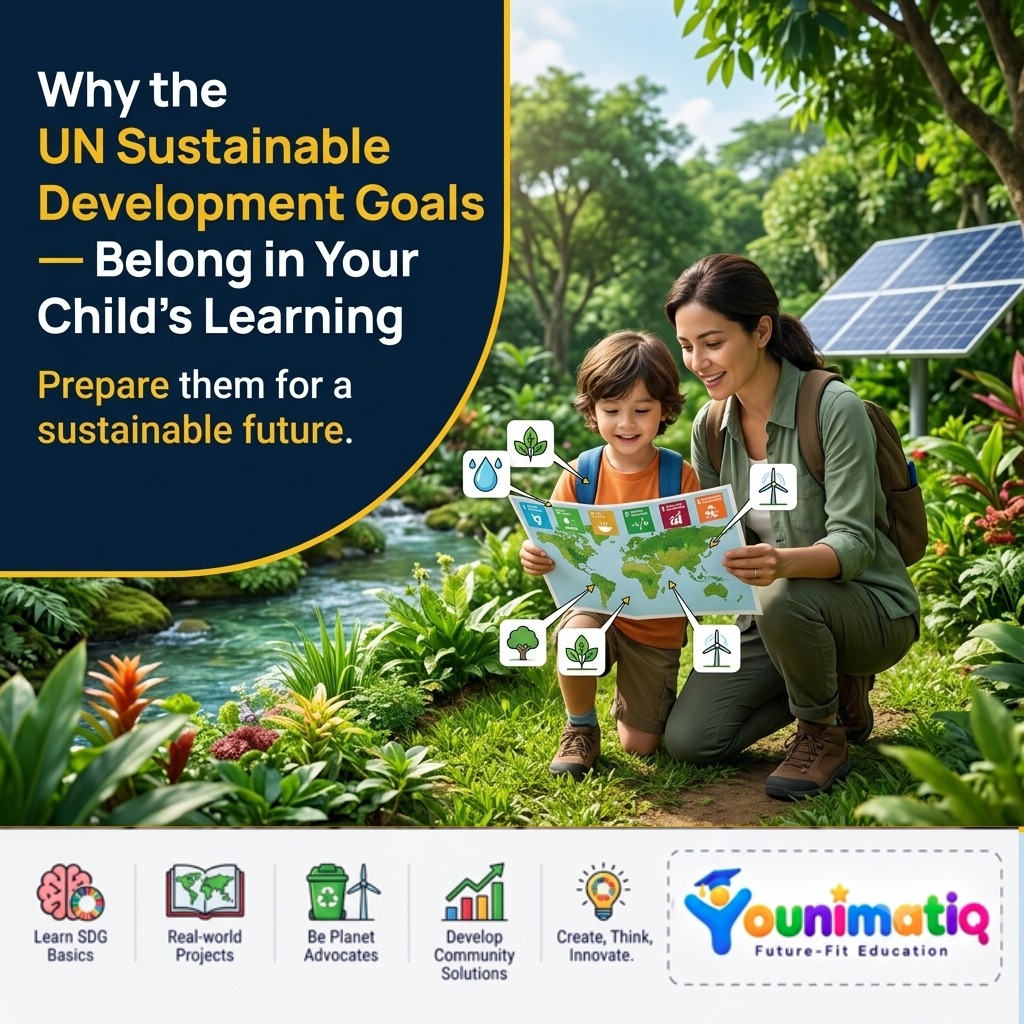
The UN Sustainable Development Goals (SDGs) are 17 goals adopted in 2015. They provide a practical plan to improve life around the world by 2030.
The goals cover major areas that affect people and the planet, including ending poverty and hunger, providing quality education and healthcare, achieving gender equality, ensuring clean water and affordable energy, creating decent jobs, reducing inequality, building sustainable cities, promoting responsible consumption, taking climate action, protecting oceans and land, and fostering peace and partnerships.
Why Do the Sustainable Development Goals Matter for Children?
The SDGs matter because they address problems that will shape the world children inherit.
Climate change already brings more intense storms, heat waves, droughts, and flooding. It also threatens food supplies, water sources, and coastal areas. When pollution, waste, and resource shortages are added to these challenges, the need for practical solutions becomes even greater.
The SDGs give countries, communities, and families a shared way to work on these issues instead of tackling every problem separately.
Children between the ages of 6 and 15 will live with the results of decisions being made today. That makes it important for them to understand how everyday actions connect to larger issues.
For example:
- Using less plastic can help protect oceans.
- Saving energy can help reduce emissions.
- Protecting forests supports wildlife and climate stability.
- Reducing water waste helps protect an important natural resource.
Early understanding can also help children develop habits that last.
A child who learns why wasting water matters may be more likely to turn off the tap. A child who understands how food waste connects to hunger and methane emissions may think twice before leaving leftovers.
Most Schools Still Treat This as Extra
Regular school systems focus on subjects such as math, reading, and science. Some schools include environmental topics, but the coverage can be limited and often remains theoretical.
A lesson might mention recycling or climate change without showing children how their everyday actions connect to larger goals. It may also provide limited opportunities for children to apply what they have learned.
For parents who care about climate change and a sustainable future, this can create a need for learning beyond the standard classroom.
They may look for programs that keep children engaged while helping them understand real-world issues and apply their knowledge in ways they can see.
Why Games and Personalized Learning Work Better
Games can hold children's attention and give them opportunities to experiment without real-world risk. They can also make abstract ideas easier to understand by turning them into something children can interact with.
For example, a younger child might play a simple simulation about sorting waste or managing a small garden.
An older child could work through scenarios involving energy use in a community or explore how different choices affect carbon levels.
This approach can make learning feel less like extra homework and more like an activity children want to explore.
Personalized Learning Makes It More Relevant
Personalized learning adjusts content to a child's age, interests, and pace.
A 7-year-old who is interested in animals might explore life on land and life below water through stories and activities about habitats.
A 13-year-old who is curious about technology could explore topics such as clean energy or sustainable cities.
This approach can help avoid one-size-fits-all lessons that may bore some children while overwhelming others.
Parents can also see progress connected to specific goals rather than only looking at generic grades.
From Theory to Something Tangible
Understanding the Sustainable Development Goals is only the beginning.
Children also need opportunities to apply what they learn in ways they can see and experience.
For climate action, a family might track household energy use or waste for a week. After looking at the results, they could choose one change, such as taking shorter showers, walking more, or improving recycling habits.
For responsible consumption, children could learn by repairing items instead of replacing them or choosing products with less packaging.
For life on land, activities might include planting native species in a yard or balcony or joining a local park cleanup.
These activities may seem small, but they are concrete.
Children can see the difference they are making through a cleaner space, a growing plant, or less trash going out. That visible result can stay with them more strongly than another worksheet.
How Younimatiq Helps Kids Move from Ideas to Action
Younimatiq uses personalized, game-based learning aligned with the SDGs.
Children engage with the material in a format that matches how they already like to spend time. The content covers the goals in age-appropriate ways and encourages children to connect ideas to their own surroundings.
Once children understand the concepts, they are better prepared to take practical steps through a home project, a school suggestion, or a community effort.
For parents looking for learning beyond the regular school system, this type of program can provide children with both knowledge and a sense that they can actually do something.
The result is not just awareness. Children can also point to something they helped create.
How SDG Learning Can Connect to Different Communities
Parents in Texas, California, New York, Florida, and Washington may have similar concerns even though the local issues can be different.
Coastal areas may deal more directly with sea-level rise and ocean health. Inland or drought-prone areas may focus more on water and heat.
The SDGs provide a common language that can work across these differences.
What to Look For When Considering Extra Learning
If you are considering an additional learning program for your child, there are a few things worth checking.
1. Accurate SDG Information
Look for materials that stay accurate to the official Sustainable Development Goals rather than using vague "green" messaging.
2. Age-Appropriate Activities
Activities should be realistic for the child's age and provide opportunities to understand and apply the concepts.
3. Follow-Through
Check whether the program encourages children to do something with what they learn rather than stopping at information.
4. Measuring Understanding
Ask how the program measures a child's understanding and whether it includes ideas for home or community projects.
The Goal Is Understanding and Action
The goal is not to turn every child into an activist overnight.
It is to give children a solid foundation and the confidence to contribute in ways that fit their lives.
Children respond when they feel the work is theirs. They like seeing a result they helped create, whether it is a reduced waste bin, a small garden, or a presentation they made for their family.
Teaching the UN Sustainable Development Goals now, in ways that stick and lead to practice, can help children participate in their future instead of simply inheriting its problems.
Programs that take this approach can help parents who want to provide their children with learning opportunities beyond what the regular school day provides.
