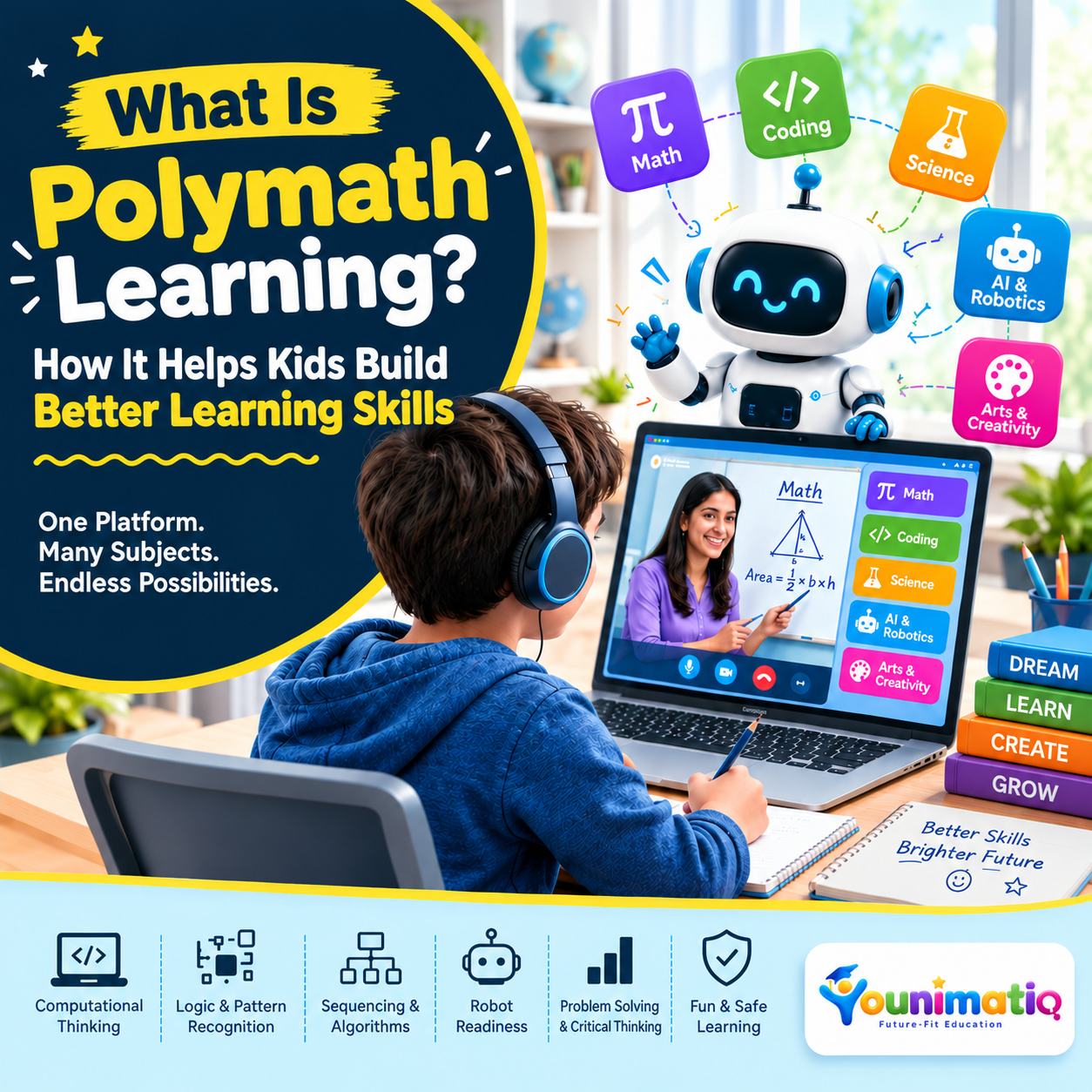
Kids naturally explore different interests. One day they may want to understand how a robot works. The next, they may be interested in drawing, coding a game, solving a math problem, or learning about space.
Polymath learning builds on this natural curiosity. Instead of treating subjects as completely separate, it encourages children to explore different areas of knowledge and find connections between them.
For parents, this approach can be useful when a child enjoys learning across several subjects and wants to understand how ideas work together.
What Is Polymath Learning?
Polymath learning is an approach where children develop knowledge and skills across multiple areas instead of focusing on just one subject.
A child might learn:
- Math through problem-solving and patterns
- Coding through game or app projects
- Science through experiments and observation
- Art through digital design and animation
- Public speaking by explaining a project
- AI by exploring how computers recognize patterns and make decisions
The goal is not to make a child an expert in everything.
Instead, children learn to connect ideas, apply what they know, and explore different ways to solve problems.
For example, a child building a simple game may use math to work with scores, coding to create game rules, creativity to design the world, and communication skills to explain how the game works.
That is the kind of cross-subject learning polymath learning encourages.
Why Does Polymath Learning Matter for Kids?
Traditional learning often divides knowledge into separate subjects. Math happens during math class, science during science class, and language during English class.
Polymath learning gives children opportunities to connect these areas.
Imagine a child designing a smart city in a game environment. They might think about:
- How much space different buildings need
- How roads should be arranged
- How energy could be used
- How technology could improve the city
- How to explain their design to others
One project can involve several types of thinking.
This helps children see that what they learn in one area can be useful somewhere else.
How Polymath Learning Can Build Better Learning Skills
1. It Encourages Children to Make Connections
Learning becomes more meaningful when children can connect new information to something they already understand.
For example, a child learning about fractions may find them easier to understand when they use them while designing or dividing something in a project.
The same idea can apply across subjects. Coding can connect with math. Science can connect with technology. Art can connect with design.
Children begin to ask questions such as:
"Where can I use this?"
That is an important learning habit.
2. It Supports Problem-Solving
Polymath learning often involves projects where there isn't just one obvious way to approach a problem.
Suppose a child is creating a simple game. The game may have a coding error, an unclear rule, or a design that doesn't work as expected.
The child has to figure out what went wrong, test an idea, make a change, and try again.
This gives them practice with a basic problem-solving process:
Understand → Try → Check → Improve
These habits can be useful across different areas of learning.
3. It Gives Kids More Ways to Explore Their Interests
Children don't always discover their strongest interests from a single school subject.
A child who enjoys Minecraft, for example, may also enjoy coding, architecture, storytelling, mathematics, or science.
Instead of dismissing the interest as "just a game," parents can look at what the child is curious about and find ways to connect it with learning.
A game can become a starting point for a project.
The same can apply to drawing, robotics, music, building, or technology.
4. It Encourages Independent Learning
When children learn across different subjects, they often have to ask questions and look for connections themselves.
For example:
"How can I make this robot move?"
That question may lead to learning about sensors, programming, movement, and problem-solving.
The important part is that the child has a reason to learn the information.
Over time, children can become more comfortable asking questions, testing ideas, and finding ways to improve their understanding.
5. It Develops Creative Thinking
Creative thinking isn't limited to art.
A child can be creative when solving a math problem, designing a robot, writing a story, building a game, or finding a different way to explain an idea.
Polymath learning gives children opportunities to approach problems from different directions.
For example, instead of simply learning about a scientific concept, a child might create a model, explain it through a presentation, or build a project around it.
Different approaches can help children discover how they learn best.
What Does It Mean to "Learn Like a Polymath"?
To learn like a polymath does not mean trying to study every subject at the same time.
It means developing the habit of learning across areas and looking for connections.
Parents can encourage this by asking questions such as:
- "What does this remind you of?"
- "Where could you use this?"
- "Can you explain how these two ideas connect?"
- "What could you build with what you learned?"
- "Is there another way to solve this?"
These questions shift the focus from simply remembering information to understanding and applying it.
Simple Examples of Polymath Learning at Home
You don't need to create a complicated learning schedule.
Start with something your child already enjoys.
If your child likes games
Explore how games are created.
They could learn about coding, storytelling, mathematics, design, and problem-solving through a game-related project.
If your child likes building
Try a project involving structures, robotics, or engineering concepts.
Ask your child to explain why they chose a particular design.
If your child enjoys drawing
Connect art with technology through digital design, animation, or creative projects.
They can explore how visual ideas are planned and created.
If your child asks lots of science questions
Turn one question into a small research or project activity.
For example, a question about how something works can lead to science, mathematics, technology, and communication.
The aim is to follow curiosity and make useful connections.
How Parents Can Support Polymath Learning
Parents don't have to teach every subject themselves.
Instead, you can create opportunities for your child to explore.
Follow interests
Pay attention to what your child chooses to do when they have free time.
That interest can become a starting point for deeper learning.
Encourage projects
Projects give children a reason to combine different skills.
A project could involve coding, building, researching, designing, writing, or presenting.
Let children explain what they learned
Ask your child to teach you something they have been working on.
Explaining an idea can help reveal what they understand and where they still have questions.
Focus on connections
When your child learns something new, ask where else that knowledge could be useful.
This encourages them to think beyond one subject.
How Younimatiq Uses Cross-Subject Learning
At Younimatiq, children can explore areas such as math, coding, science, AI, robotics, public speaking, arts and animation, Minecraft, and Roblox.
The idea is to give children opportunities to learn through different interests and apply skills in projects.
For example, a child interested in Minecraft can explore math, science, coding, or AI through Minecraft-based learning. A child interested in robotics can work with technology, coding, problem-solving, and creative thinking.
This type of learning can help children see relationships between subjects instead of viewing each subject as a separate box.
Is Polymath Learning Right for Every Child?
Children have different interests, learning preferences, and levels of curiosity.
Some may enjoy exploring several subjects. Others may prefer spending more time developing one particular skill.
Polymath learning doesn't require children to study everything.
The useful idea is to give children room to explore, connect ideas, and apply what they learn.
If your child regularly jumps from one interest to another, you can use those interests as opportunities rather than seeing them as distractions.
Final Thoughts
Polymath learning is about helping children become flexible learners.
Instead of asking only, "What subject are you learning?", parents can also ask:
"What can you do with what you learned?"
A child who learns to connect math with coding, science with technology, or creativity with problem-solving starts to see learning differently.
The goal isn't to raise a child who knows everything. It's to help them become curious, adaptable, and comfortable exploring ideas across different areas.
That mindset can make learning more connected and purposeful—one interest at a time.
