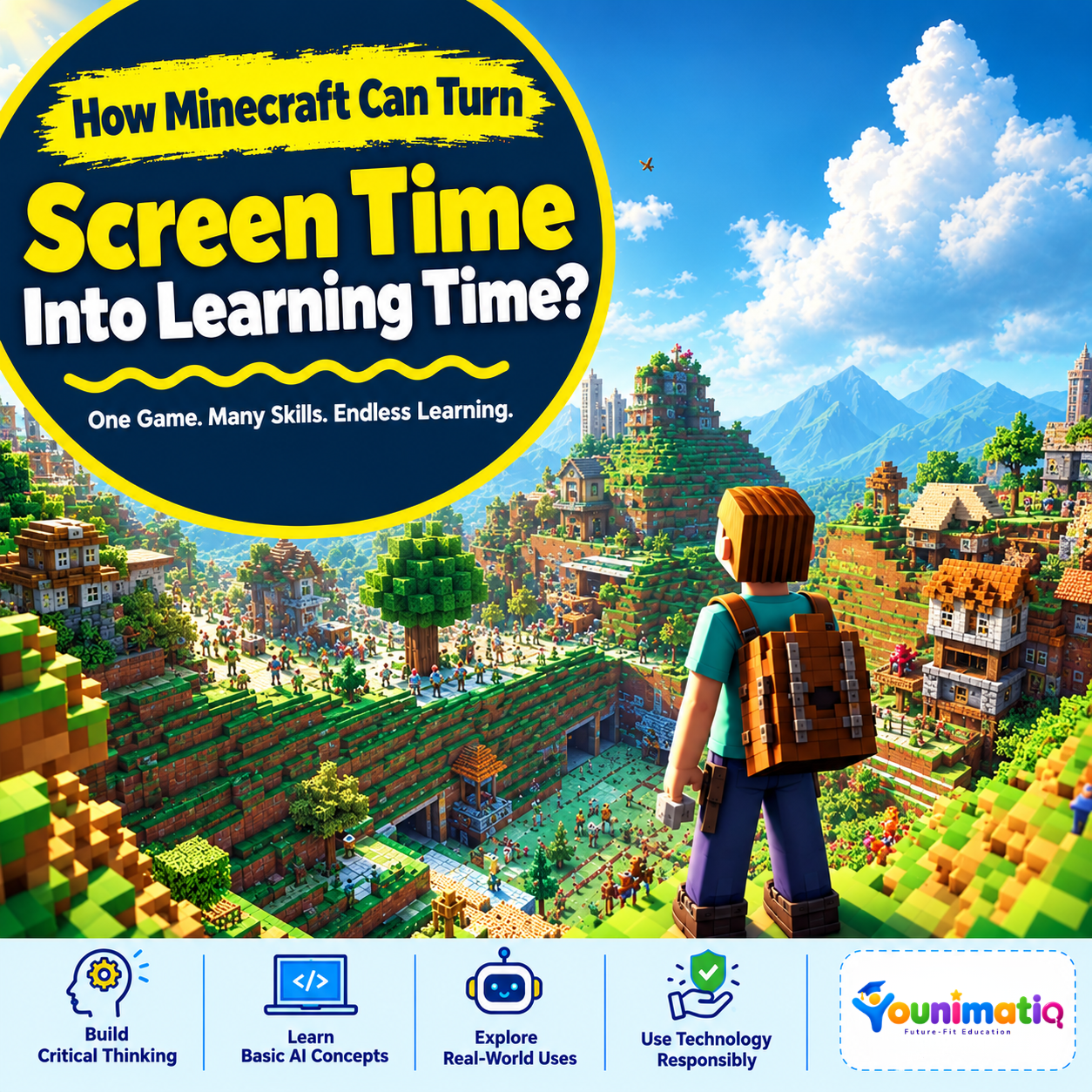
For many parents, screen time is a daily challenge. Children may spend time playing games, watching videos, or exploring apps, and parents often wonder if that time could be used in a more meaningful way.
Minecraft can offer a different approach. With the right activities and guidance, a game can become a space where children practise problem-solving, creativity, planning, and other useful skills.
This is where Minecraft education can make a difference. Instead of simply playing for entertainment, children can use Minecraft-based activities to explore ideas and apply what they learn.
What Is Minecraft Education?
Minecraft Education is an educational version of Minecraft designed for learning. It provides a game-based environment where students can explore concepts, create projects, solve problems, and work through structured activities.
The familiar Minecraft environment can make learning feel more interactive. A child who enjoys building houses, exploring worlds, or creating structures may become more interested when those same interests are connected to a learning activity.
Parents may also come across the term Minecraft Education Edition. It refers to the education-focused version of Minecraft that has been used for classroom and learning activities.
The important point is that the value comes from how Minecraft is used. Simply giving a child more time to play does not automatically make screen time educational.
How Minecraft Can Support Learning
1. It Encourages Problem-Solving
Minecraft regularly gives children problems to work through.
They may need to decide what materials they need, plan how to build something, figure out how different elements work together, or change their approach when something does not work.
For example, a child building a structure may first create a simple design and then realise that it needs changes. They have to identify the problem and find a solution.
These small decisions can encourage children to think rather than simply consume content.
2. It Makes Learning More Hands-On
Some children understand ideas better when they can interact with them.
Minecraft can provide a visual and interactive environment for exploring concepts. Instead of only reading about a structure, a child can create one. Instead of simply hearing about planning, they can plan and build their own project.
This hands-on approach can make certain learning activities easier to understand and remember.
3. It Can Develop Creativity
Building in Minecraft gives children considerable freedom to create.
A child might design a building, create a landscape, construct a model, or develop a game-related project. They have to make choices about how their idea should look and how different parts should fit together.
Parents can make this more meaningful by asking questions such as:
- What are you trying to build?
- Why did you choose this design?
- What would you change?
- How can you make it work better?
These questions encourage children to explain their thinking instead of simply showing the finished creation.
4. It Can Connect Different Subjects
One useful feature of game-based learning is that a single activity can involve more than one subject.
For example, a Minecraft project could involve:
- Math: measuring, counting, patterns, shapes, and basic calculations
- Science: exploring systems, structures, environments, and cause-and-effect relationships
- Coding: creating instructions and solving programming problems
- English: writing descriptions, stories, instructions, or project explanations
- History: recreating or exploring structures and settings connected to historical topics
This type of activity can help children see connections between subjects rather than treating every subject as completely separate.
Minecraft and Coding
Minecraft can also be a useful starting point for children who are interested in technology.
With appropriate learning activities, children can move from simply building things to understanding how instructions, logic, and coding work.
For example, a child could learn to give a computer-controlled character a sequence of instructions. They can then test those instructions, find mistakes, and make changes.
This introduces an important coding habit: try, test, find the problem, and improve the solution.
For children who already enjoy Minecraft, connecting the game with coding can make programming concepts feel more approachable.
How Parents Can Make Minecraft Screen Time More Useful
Parents do not necessarily need to remove games completely. A better approach can be to give screen time a clear purpose.
Here are a few practical ways to do that.
Set a Learning Goal
Instead of saying, "Go play Minecraft," give the child a simple challenge.
For example:
"Can you design a small house using a specific number of blocks?"
Or:
"Can you build a model and explain how you made it?"
A clear goal changes the activity from open-ended play into a project.
Ask Your Child to Explain Their Work
When your child finishes a Minecraft project, ask them to explain what they created.
What was the plan? What problems did they face? What did they change?
Explaining the process can be just as valuable as completing the project.
Connect Minecraft to Schoolwork
If your child is learning a topic at school, look for appropriate ways to connect it with Minecraft.
For example, after learning about shapes, a child could explore how different blocks can be arranged to create structures. A writing assignment could involve describing a Minecraft world or creating a story around a character.
The goal is to use Minecraft as a tool for exploring an idea, rather than treating the game itself as the lesson.
Is Minecraft Educational for Every Child?
Minecraft can support learning, but it is not automatically educational for every child or in every situation.
The activity, guidance, and learning objective matter.
A child spending hours playing without any meaningful goal is still primarily spending time gaming. On the other hand, a structured Minecraft project can give children an opportunity to practise creativity, planning, problem-solving, communication, and technology skills.
Parents should also consider their child's age, interests, overall screen habits, and the type of content they are accessing.
Minecraft as One of Many Learning Games for Kids
Minecraft is one example of how games can be used as part of a broader learning experience.
There are many learning games for kids, but parents should look beyond whether a game is labelled "educational." A useful question is: What is my child actually doing while using it?
Are they solving problems? Creating something? Making decisions? Explaining ideas? Practising a skill?
The answers can help parents decide whether a particular game or activity is worth including in their child's learning routine.
How Younimatiq Uses Minecraft for Learning
At Younimatiq, Minecraft can be used as a learning environment where children explore academic and technology-related concepts through projects and guided activities.
Its Minecraft-focused learning options can connect the familiar game environment with areas such as math, science, coding, AI, 3D building, game design, Redstone circuits, Python AI/ML, and modding.
This approach gives children a way to explore subjects through something they already enjoy while working with structured learning goals.
For parents, the bigger idea is simple: screen time does not have to mean passive entertainment every time. With the right activity and guidance, a game like Minecraft can become a starting point for children to build, experiment, solve problems, and create.
Final Thoughts
Minecraft can be more than a game when children use it with a clear learning purpose.
It can give them opportunities to build projects, test ideas, solve problems, explore different subjects, and develop their creativity. The key is not simply increasing screen time. It is making some of that time more purposeful.
For parents looking for practical ways to combine children's interests with learning, Minecraft education can be one option worth exploring.
