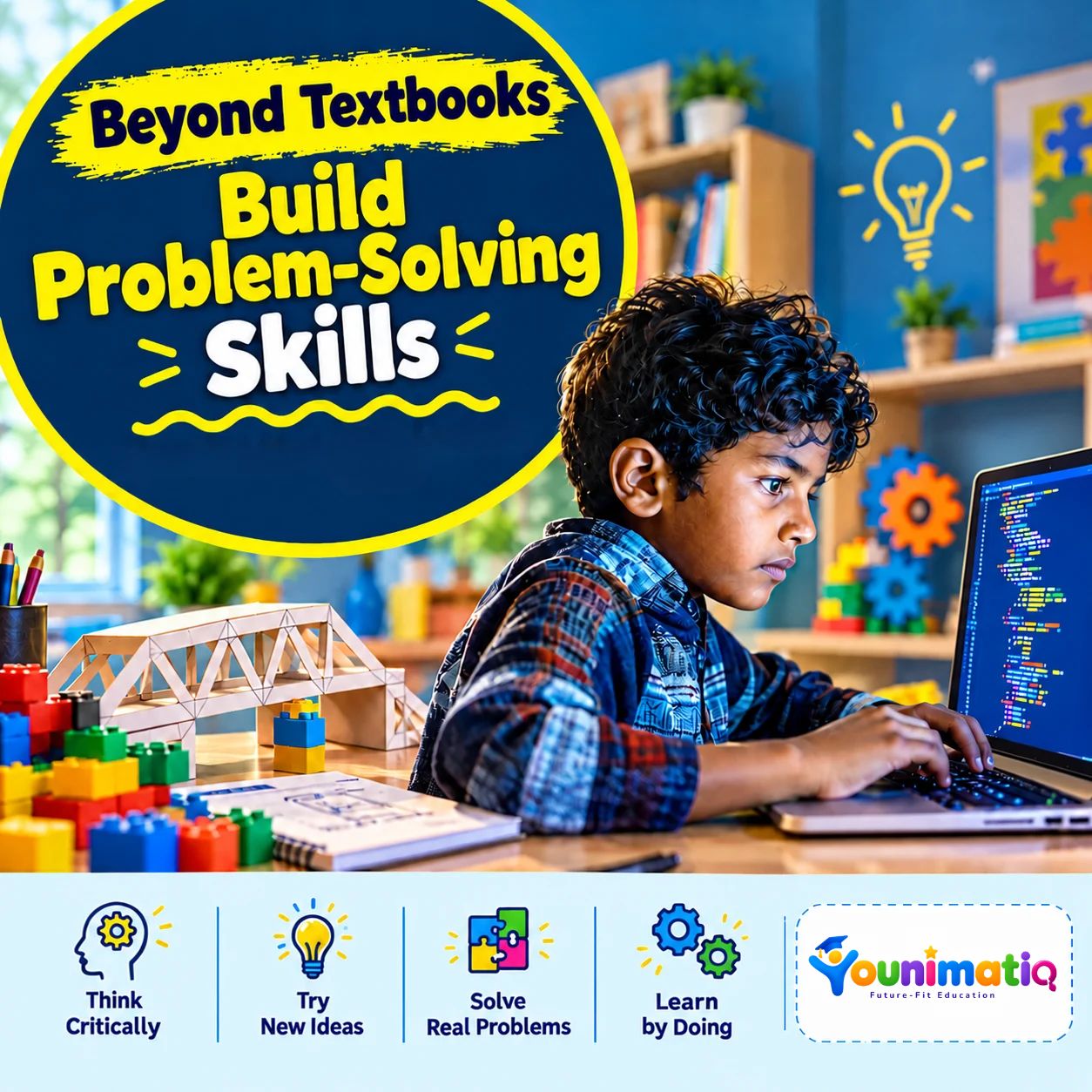
Coding is often introduced to children as a way to learn programming languages and build games, websites, or simple applications. But the value of coding goes beyond creating something on a screen. It gives children regular opportunities to think through problems, test ideas, find mistakes, and try different solutions.
Coding can be a valuable learning activity alongside school education. Through hands-on projects, coding and problem solving go hand in hand, helping children gradually develop logical thinking skills, find solutions to challenges, and learn from their mistakes.
What Does Coding Have to Do With Problem-Solving?
Coding requires a child to break a larger task into smaller steps.
For example, imagine a child wants to create a simple game where a character moves when the player presses a key. The child needs to think about several questions:
- What should happen when the key is pressed?
- Which direction should the character move?
- How far should it move?
- What happens if the character reaches an obstacle?
- What should happen when the game ends?
Instead of trying to solve everything at once, the child works through each part. This way of thinking is closely connected to problem-solving.
The child learns to understand the problem first, create a possible solution, test it, and make changes when the result is different from what was expected.
1. Coding Teaches Kids to Break Problems Into Smaller Parts
Large problems can feel difficult when children look at them as one task. Coding teaches them to divide the task into manageable steps.
Suppose a child is building a quiz game. They may need to:
- Display a question.
- Show possible answers.
- Check the selected answer.
- Decide if it is correct.
- Add points for a correct answer.
- Move to the next question.
This approach can help children understand that a difficult problem does not always need one complicated solution. It can often be solved by handling smaller problems one at a time.
2. Coding Builds Logical Thinking Skills
Programs work according to instructions and conditions. Children therefore have to think carefully about what should happen and when.
For example:
If the player's score reaches 10,
then move to the next level.
A child working with conditions like this begins to think about cause and effect. They learn to ask, "What should happen if this condition is true?" and "What should happen if it is false?"
These are useful logical thinking skills that can support learning in different areas.
3. Debugging Teaches Children to Learn From Mistakes
One of the most useful parts of learning to code is debugging.
A program may not work because a child used the wrong instruction, missed a step, or placed something in the wrong part of the code. Instead of simply being told the answer, children can investigate what went wrong.
For example, a character might move left when the child wanted it to move right. The child can check the relevant instruction, identify the mistake, change it, and test the program again.
This creates a practical problem-solving cycle:
Try → Test → Find the problem → Fix → Test again
Children learn that a mistake is information. It tells them something about the solution they are working on.
4. Coding Encourages Children to Try Different Solutions
There is often more than one way to solve a programming problem.
A child might create a particular game feature using one approach and later discover another way to achieve the same result. Comparing these approaches can encourage them to think about which solution is easier to understand or change.
For younger learners, this can start with visual programming tools where they arrange blocks to control characters or objects. As they become more comfortable, they can move toward text-based programming.
The important part is the thinking process rather than simply learning programming commands.
5. Coding Helps Kids Think About Cause and Effect
Children constantly make predictions while coding.
They might ask:
- "What will happen if I change this number?"
- "What happens if I remove this block?"
- "Why did the character stop moving?"
- "Why did this part repeat?"
They then run the program and compare the result with their prediction.
This gives children a practical way to understand cause and effect. They can change one part of a program, observe what happens, and use that result to decide what to try next.
6. Coding Develops Step-by-Step Thinking
A computer needs instructions in a particular order. Children therefore need to think about sequence.
Consider a simple game:
Start → Move → Collect an object → Check the score → Continue
If the instructions are in the wrong order, the game may not behave as expected.
Learning to organize steps can help children become more deliberate when approaching tasks. Instead of immediately guessing an answer, they can learn to consider what needs to happen first, what comes next, and what result they are trying to achieve.
7. Coding Gives Children Hands-On Problem-Solving Practice
Reading about problem-solving is different from actually solving a problem.
Coding gives children something they can build and test. They can see the result of their decisions almost immediately.
For example, a child could be asked to create a simple maze. They need to decide how the character will move, how obstacles will work, and what should happen when the character reaches the destination.
If the maze does not work, the child has a specific problem to investigate. This makes the learning process more active.
How Parents Can Encourage Problem-Solving Through Coding
Parents do not need to be programmers to support their child's learning.
A few simple habits can make coding sessions more useful.
Ask Questions Instead of Giving the Answer
If your child gets stuck, try asking:
- "What were you expecting to happen?"
- "What happened instead?"
- "Which part was working before?"
- "What could you test first?"
These questions encourage the child to investigate the problem rather than immediately depending on someone else for the solution.
Let Children Experiment
Give children some space to change their code and see what happens. Small experiments can help them understand how different instructions affect the final result.
They may make mistakes along the way, and that is part of the learning process.
Choose Projects That Match Their Interests
A child who enjoys games may be more interested in creating a simple game. Another child might enjoy animations, stories, robots, or interactive projects.
When the project is meaningful to the child, there is a practical reason to solve the problems that appear during the process.
What Are the Benefits of Coding for Children?
The benefits of coding can extend beyond learning how to write programs. With regular practice, children can get opportunities to develop:
- Problem-solving habits
- Logical thinking skills
- Step-by-step reasoning
- Attention to detail
- Debugging and testing habits
- Creative approaches to challenges
- Confidence in working through difficult tasks
The level of these benefits depends on the child's age, learning approach, projects, and the guidance they receive.
Coding should therefore be treated as a learning process rather than simply memorizing programming syntax.
How Younimatiq Uses Coding as a Learning Activity
At Younimatiq, coding is part of a broader approach to helping children learn through practical activities and projects.
Instead of focusing only on programming commands, children can work on projects that require them to think, test, correct mistakes, and build their ideas step by step.
For parents looking for online learning options, the right coding program should match the child's age and interests while giving them enough opportunities to solve problems independently.
Frequently Asked Questions
At what age can children start learning coding?
Children can start with age-appropriate coding activities when they are ready to follow simple instructions and work through basic challenges. Younger children can begin with visual or block-based activities before moving to text-based programming.
Does coding improve problem-solving skills?
Coding gives children frequent practice with breaking tasks into smaller steps, testing solutions, identifying errors, and trying again. These activities can support the development of problem-solving skills.
Is coding useful for children who do not want to become programmers?
Yes. Coding can be treated as a way to practice logical thinking and problem-solving, even if a child does not plan to pursue programming as a career.
How can parents make coding more engaging?
Start with projects connected to the child's interests. Games, animations, stories, robotics, and interactive projects can give children a clear reason to use what they are learning.
A Useful Skill Beyond the Screen
Coding gives children a structured environment where they can face a problem, make a plan, test an idea, discover an error, and improve their solution.
That process is at the heart of coding and problem solving.
For parents, the goal does not have to be turning every child into a programmer. A good coding experience can simply help children become more comfortable with challenges and more willing to work through problems instead of giving up when the first solution does not work.
